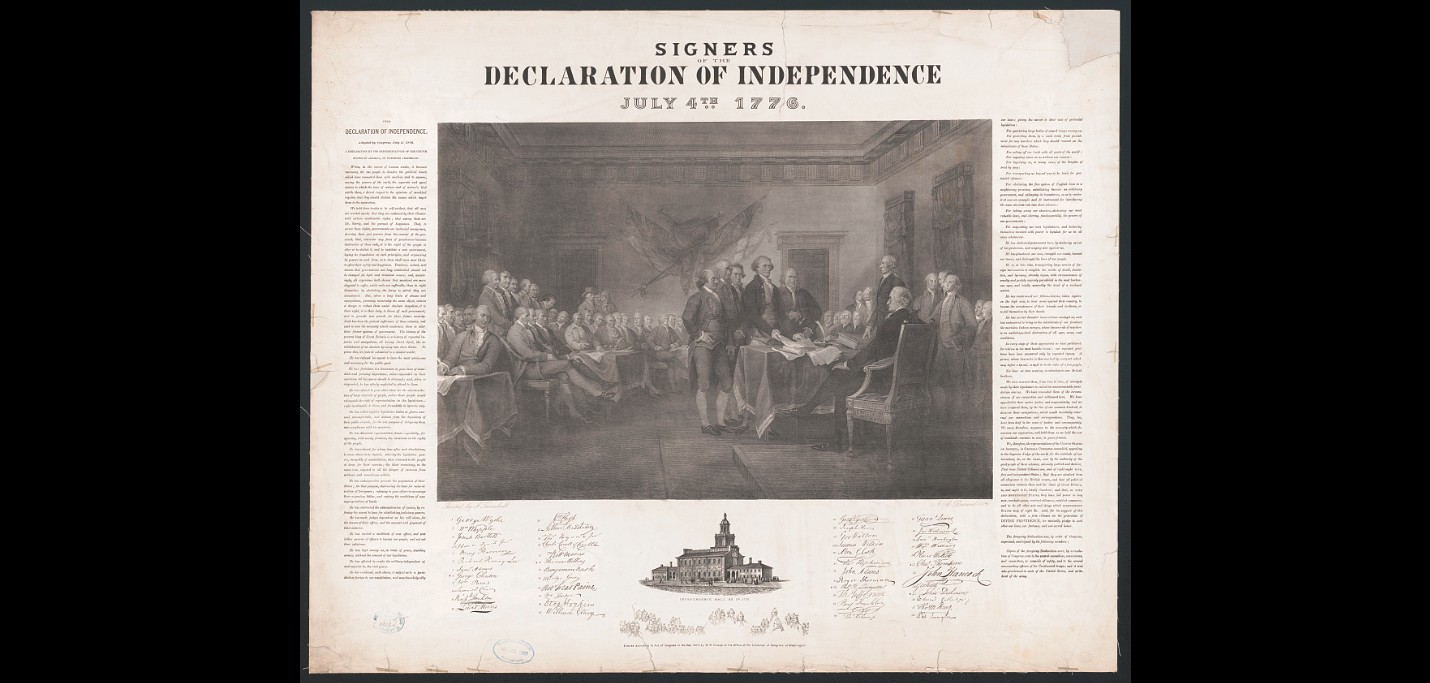
“In Congress” means the Second Continental Congress meeting in the Pennsylvania State House in Philadelphia. This is where and when the Declaration of Independence was signed.
In 1770 North America, the British Empire included Canada and the 13 American colonies, informally divided as: the New England Colonies (New Hampshire, Massachusetts, Rhode Island, and Connecticut); the Middle Colonies (New York, New Jersey, Pennsylvania, and Delaware); and the Southern Colonies (Maryland, Virginia, North Carolina, South Carolina, and Georgia).
Because Canada was a former French colony and easily assimilated along colonial administrative procedures, it was governed more directly by Britain than the 13 British American colonies. Because communication took a long time, these colonies developed fledgling “governments,” often assemblies, to manage their own issues. In some manner, they operated alongside the British Crown’s representatives. By the time the Second Continental Congress first met in May 1775, King George III had still not replied to the petition for redress of grievances that had been sent by the First Continental Congress. For all intents and purposes, the Second Continental Congress was the on-site government of the American colonies. This Congress established the Continental Army, an American continental currency, a post office for the “United Colonies, and the committees that included the Committee of Five, aka the Committee on Independence.
Starting in the early 1770s, it was becoming apparent to the American colonists that rights they had taken for granted were being withdrawn. Also, the demographics were changing. No longer primarily British subjects, the ‘melting pot’ was already happening. Between 1700 and 1770, 278,400 enslaved people were brought in, primarily from West Africa; 52,200 white convicts; 103,600 indentured servants (another form of enslavement); and 151,600 free immigrants, who came from all the British Isles, Germany, the Netherlands, Spain, France, Switzerland, Sweden, Finland, and a few from other countries.
At the Second Continental Congress on June 7, 1776, Richard Henry Lee, representative from Virginia, read the following resolution:
“Resolved: That these United Colonies are, and of right ought to be, free and independent States, that they are absolved from all allegiance to the British Crown, and that all political connection between them and the State of Great Britain is, and ought to be, totally dissolved.
That it is expedient forthwith to take the most effectual measures for forming foreign Alliances.
That a plan of confederation be prepared and transmitted to the respective Colonies for their consideration and approbation.”
The Congress set up three committees to draft plans addressing these issues. One of these was the Committee of Five, also called the Committee on Independence, composed of John Adams, Benjamin Franklin, Thomas Jefferson, Robert R. Livingston, and Roger Sherman. Their purpose was to draft a declaration of independence, which they obviously did from June 11, 1776, until July 5, 1776, when it was actually published. It was formally adopted by the Second Continental Congress’s 56 delegates the morning of July 4, 1776.
Here are some of its statements of particular interest in our times from an original transcript with that spelling and punctuation. “He” refers to King George III, of the British Empire.
“He has endeavoured to prevent the population of these States; for that purpose obstructing the Laws for Naturalization of Foreigners; refusing to pass others to encourage their migrations hither, and raising the conditions of new Appropriations of Lands.
He has made Judges dependent on his Will alone, for the tenure of their offices, and the amount and payment of their salaries.
He has combined with others to subject us to a jurisdiction foreign to our constitution, and unacknowledged by our laws; giving his Assent to their Acts of pretended Legislation:
For cutting off our Trade with all parts of the world:
For depriving us in many cases, of the benefits of Trial by Jury:
For transporting us beyond Seas to be tried for pretended offences:
For taking away our Charters, abolishing our most valuable Laws, and altering fundamentally the Forms of our Governments:
He has plundered our seas, ravaged our Coasts, burnt our towns, and destroyed the lives of our people.
He has excited domestic insurrections amongst us,….”
https://www.archives.gov/founding-docs/declaration-transcript